HELP! My Bathroom Ceiling is Peeling
Help for the peeling bathroom ceiling
11/15/20253 min read
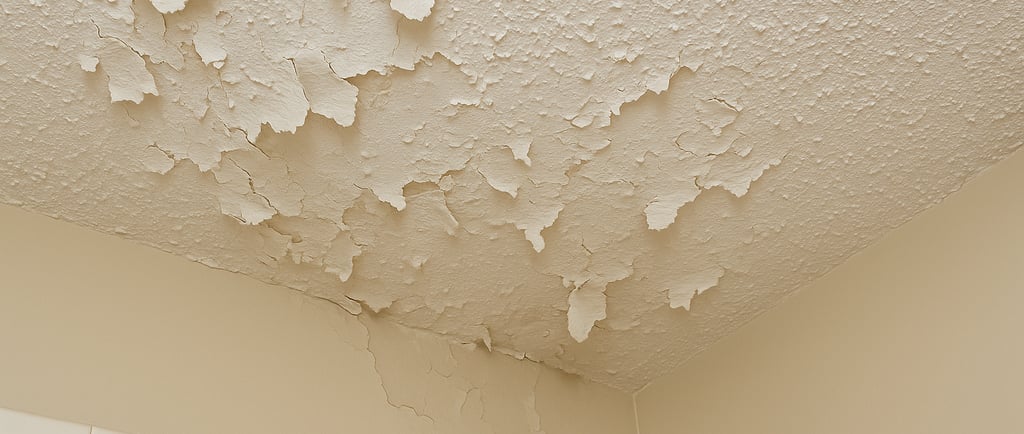
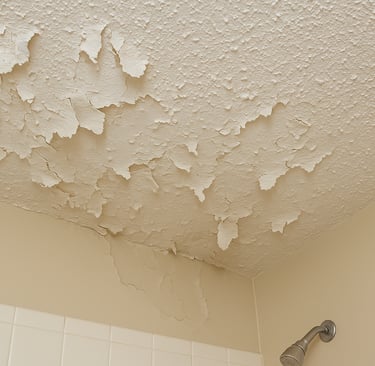
Bathroom Ceiling Is Peeling. Here’s Why (And How to Fix It).
There is nothing quite as annoying as relaxing in a hot shower, looking up, and seeing your ceiling paint hanging down like peeling skin from a bad sunburn.
It looks unsightly, it makes the room feel dirty, and worst of all—it seems to keep spreading no matter how many times you scrape it off.
If your bathroom ceiling is flaking, cracking, or bubbling, you aren't alone. This is one of the most common issues we see in residential painting. The good news? It is fixable. But to fix it permanently, you have to understand why it is happening in the first place.
The Public Enemy #1: Moisture
The simple answer is almost always moisture. But it’s a little more complex than just "water got on it."
Bathrooms are unique environments. When you take a hot shower, steam rises. If that steam has nowhere to go, it condenses on the coolest surface available—usually your ceiling.
Here is the chain reaction that causes the peel:
Condensation: Water droplets sit on the surface of the paint.
Penetration: If the paint is low quality or the wrong finish, the water seeps through the paint layer.
Separation: The moisture gets between the paint and the drywall or plaster. This breaks the chemical bond (adhesion).
Gravity: Once the bond is broken, gravity takes over, and the paint begins to flake or bubble.
Other Contributing Factors
While moisture is the main villain, it usually has accomplices. Your ceiling is more likely to peel if:
Poor Ventilation: Your exhaust fan is broken, dirty, or not powerful enough for the size of the room.
Improper Prep: The previous painter painted over a dirty or dusty surface, meaning the paint never truly stuck in the first place.
The Wrong Paint: This is the most common technical error. Using standard "flat" ceiling paint in a humid bathroom is a recipe for disaster.
The Solution: Specific Paints for Specific Environments
You cannot simply paint over the peeling area with the leftover can you used in the hallway. Bathroom ceilings require armor.
1. The Sheen Matters
In the rest of the house, we love Flat or Matte paint for ceilings because it hides imperfections. In a bathroom, however, Flat paint is like a sponge—it absorbs moisture.
For bathrooms, we almost always recommend a Satin or Semi-Gloss finish.
Why? These finishes have a tighter molecular structure. They create a hard, shiny "shell" that repels water. When steam hits a Satin finish, it sits on top and evaporates rather than soaking in.
2. Moisture-Resistant & Mildewcide Formulas
Standard wall paint isn't enough. You need a product specifically engineered for high-humidity environments.
The Tech: Look for high-quality paints labeled "Bath & Spa" or "Kitchen & Bath." These paints often contain mildewcides (chemicals that prevent mold growth) and are formulated to resist "surfactant leaching" (those ugly brown drip marks on walls).
Top Contenders: Products like Benjamin Moore Aura Bath & Spa or Sherwin-Williams Duration Home are industry leaders. Interestingly, some of these newer premium paints allow for a matte finish while still providing mildew resistance, giving you the best of both worlds.
How We Fix It (The Right Way)
If you just paint over the problem, it will peel again in six months. Here is the professional process for a lasting repair:
Scrape and Sand: We remove every bit of loose paint until we reach a solid edge. We then sand the edges to "feather" them, so you don't see a ridge where the old paint meets the bare drywall.
Deep Clean: This is crucial. We clean the ceiling with a TSP (Trisodium Phosphate) substitute or a bleach solution to kill any invisible mildew spores and remove soap scum.
Oil-Based Primer: In severe cases, we use an oil-based stain-blocking primer. Oil repels water better than latex. This seals the drywall and creates a sticky surface for the topcoat.
The Topcoat: We apply two coats of premium, moisture-resistant bathroom paint.
How to Prevent It Coming Back
Once your ceiling is restored, keep it that way!
Run the Fan: Turn your exhaust fan on before you start the water and leave it running for 20–30 minutes after you finish.
Check the Vent: Make sure your fan is actually venting outside, not just into your attic (which causes roof rot).
Is Your Ceiling Ready for a Refresh?
Dealing with peeling paint is messy, and working overhead is a pain in the neck—literally. If you want your bathroom to look fresh, clean, and spa-like again, let us handle the prep and painting for you.
PROFESSIONAL SERVICES
Offering Expert Painting and Power Washing Services for the Greater Minneapolis Metro Area
Contact:
Brian Wolf- OWner
Site Created by Horizon Creative Co. © 2025. All rights reserved.
Follow Us!
Nextdoor